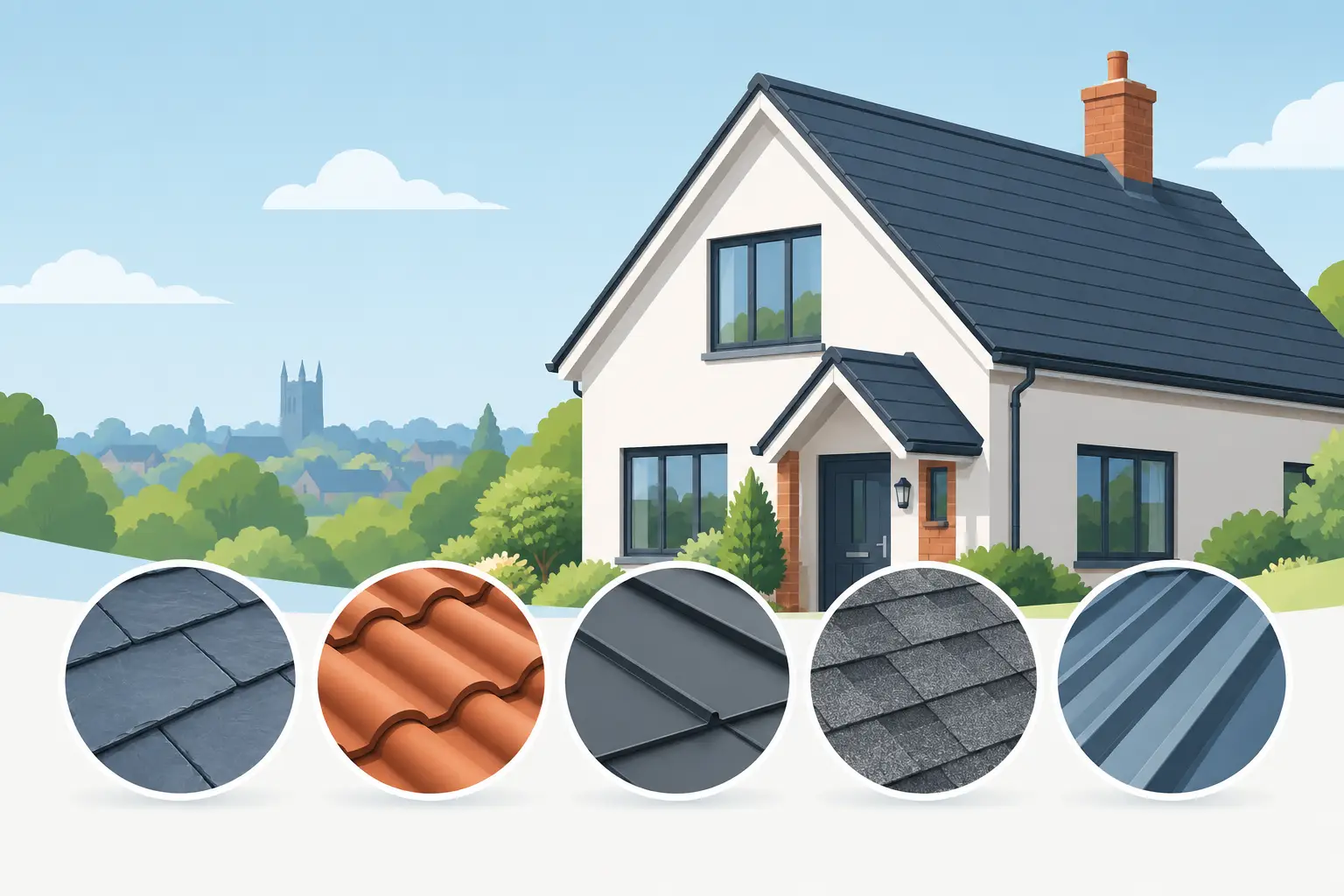
A roof can look sound from the ground while its fixings, flashings or underlay are approaching failure. Choosing the best roofing materials UK properties require is therefore about far more than selecting an attractive covering. The right material must suit the building, its roof pitch, local exposure to wind and rain, and the standard of installation needed to protect the structure beneath.
For homes in Redhill and across the wider GB market, the strongest choice is rarely the cheapest one at the outset. A well-specified roof covering, fitted with accurate detailing and compatible ancillary materials, can protect a property for decades. A poor match between material, roof structure and workmanship can lead to recurring leaks, premature repair costs and damage to the character of the building.
Best roofing materials UK property owners should consider
There is no single best material for every roof. Slate may be the natural choice for a period property, while a modern home or extension may benefit from precision-installed clay tiles or a high-performance flat roofing membrane. The decision should begin with the roof itself: its pitch, load-bearing capacity, drainage arrangement, existing construction and architectural setting.
Natural slate for longevity and architectural character
Natural slate remains one of the finest roofing materials for traditional and architecturally sensitive properties. Its dense structure, low water absorption and distinctive appearance make it particularly well suited to pitched roofs where longevity and visual quality are priorities. A properly selected and installed slate roof can have an exceptionally long service life.
Slate is not, however, a material to fit casually. Individual slates vary in thickness and character, and the roof requires correct setting out, secure fixings and carefully formed details at valleys, abutments and roof edges. The supporting structure must also be capable of carrying the weight. Reclaimed slate can be valuable when retaining the appearance of an older roof, but it needs specialist assessment for condition, thickness and consistency before reuse.
For period houses, slate often offers the most sympathetic result. It preserves crisp roof lines and a depth of finish that imitations rarely match. Its higher initial cost is balanced by its lifespan, repairability and contribution to the property’s character.
Clay tiles for enduring colour and refined detail
Clay tiles are another premium option, valued for their warm tones, dimensional finish and proven durability. They work particularly well on heritage-style homes, conservation-sensitive settings and properties where roof appearance is a significant part of the architectural design. Unlike surface-coloured alternatives, the colour of quality clay is integral to the material and tends to weather with distinction.
Clay tiles can suit a range of roof pitches, but the precise tile profile, gauge and fixing method must be selected for the roof’s exposure and geometry. Some clay tiles have a traditional irregularity that suits older properties, while machine-made products provide a more uniform finish for new-build and refurbishment work.
The trade-off is weight and cost. Clay is generally heavier than many modern alternatives, so the roof structure must be assessed before a change of covering. It also demands careful handling during installation. Correctly detailed verges, hips and abutments are essential to ensure the finished roof looks as good as it performs.
Concrete tiles for dependable value
Concrete tiles are widely used across the UK because they offer a practical balance of strength, availability and cost. Modern concrete tile ranges are available in profiles and colours that can complement both traditional and contemporary homes. They are a sensible option where a durable pitched roof is required without the investment associated with natural slate or premium clay.
Their limitations should be considered honestly. Concrete tiles are relatively heavy, and their surface can weather differently over time depending on the finish and local conditions. On a high-quality period property, they may not provide the same visual refinement as slate or clay. They can nevertheless deliver a reliable, weather-resistant roof when the structure, battens, underlay and mechanical fixings are specified correctly.
For landlords, property managers and homeowners planning a full roof renewal, concrete can be a sound choice where long-term serviceability matters more than reproducing a historic material exactly.
Fibre cement slates for lighter roof structures
Fibre cement slates offer a lightweight, consistent alternative to natural slate. They can be especially useful where structural loading is a concern, or where a clean, regular slate appearance is desired at a more controlled cost. Available in a wide range of sizes and colours, they give designers and property owners flexibility without the variation found in quarried slate.
This material is particularly suited to certain extensions, modern homes and replacement roofs where planning requirements do not demand natural slate. It is important not to treat it as a direct like-for-like substitute for a historic slate roof. The finish, edge detail and weathering characteristics differ, and that distinction may matter greatly on a character property.
Installation accuracy remains central. Fibre cement slates need suitable fixings, correct lap and careful cutting around penetrations. A roof is only as dependable as the junctions where water is directed, collected or discharged.
Flat roofing membranes for extensions and low-pitch areas
Flat and low-pitch roofs need materials designed for standing water, thermal movement and controlled drainage. Felt systems, single-ply membranes and liquid-applied waterproofing each have a place, depending on the roof design, access requirements and intended finish.
High-performance felt systems can provide durable protection when installed in properly bonded layers with precise detailing at upstands and outlets. Single-ply membranes are lightweight and can be effective on larger roof areas. Liquid systems are useful for complex shapes, repairs and areas with multiple penetrations because they form a continuous waterproof layer.
The best option depends on the condition of the deck, insulation build-up, falls and existing roof construction. A flat roof should never be judged by its surface alone. Water often enters at poorly formed edges, outlets, rooflights, pipe penetrations or abutments. These are the details that demand specialist workmanship.
Leadwork is part of the roofing material decision
Lead is not usually the main roof covering on a domestic property, yet it is one of the most important materials in protecting it. Lead flashings, soakers, valleys, gutters and weatherings manage water where roofs meet walls, chimneys, dormers and changes in level. When these details fail, even a roof with excellent tiles or slates can leak.
Artisanal leadwork requires a clear understanding of expansion, correct sizing, fixing methods and lap dimensions. Lead must be formed and supported to allow for natural movement through changing temperatures. Overly long pieces, poor fixing or incorrect detailing can cause splits and water ingress long before the surrounding roof covering reaches the end of its life.
On period and character properties, leadwork also has a visual role. Neat, accurately dressed flashings and valleys protect the building while preserving the crisp lines that distinguish quality roofing from basic repair work.
How roof pitch, exposure and structure affect the choice
Material selection should be led by the building rather than fashion. A shallow-pitched roof may require a specific tile, slate system or membrane rated for that pitch. A highly exposed location may need enhanced mechanical fixing to resist wind uplift. Properties beneath trees may need materials and details that make maintenance and drainage easier to manage.
The existing roof structure is equally important. Replacing lightweight covering with concrete or clay tiles can add significant load. Conversely, removing a traditional material without considering the building’s appearance may reduce its value and visual coherence. An expert survey should examine rafters, decking, battens, ventilation, insulation and the condition of chimneys and abutments before a final specification is made.
Compatibility matters throughout the roof build-up. The covering, underlay, battens, fixings, ventilation provision and flashings must work as a complete system. Selecting a premium slate or tile is of limited value if the supporting details are poorly planned.
When repair is better than replacement
A few slipped slates, cracked tiles or deteriorated flashings do not automatically mean a full replacement is necessary. Targeted repairs can often restore weather resistance where the main roof covering remains serviceable. This is particularly relevant on older roofs, where retaining sound original slate or tile can be preferable to wholesale renewal.
Replacement becomes more appropriate when failures are widespread, the roof covering is near the end of its life, or underlying components such as battens and underlay have degraded. Recurrent leaks should be investigated rather than repeatedly patched. The visible point of water entry is not always the true source of the fault.
For any substantial roofing project, ask for a material recommendation that explains why it suits your property, not simply what is readily available. C Smith Roofing Specialist approaches each roof as a protective system, combining expert installation, structural awareness and precise lead detailing. The right material, fitted with care, gives a property the lasting protection it deserves.